December 07, 2016

The Caine Prize for African Writing 2016 Anthology | Book Review

The Caine Prize for African Writing is a prestigious literary prize awarded to African writers annually beginning in the year 2000. Each year an anthology comprising of shortlisted stories and workshop stories is published by New Internationalist in the UK and in 8 African countries (South Africa, Nigeria, Kenya, Zimbabwe, Ghana, Zambia, Cameroon & Uganda). This is my second year reviewing the anthology series on my blog. Last year's anthology was titled Lusaka Punk and Other Stories. This year's anthology is titled The Daily Assortment of Astonishing Things and Other Stories. The collection begins with the five shortlisted stories and then continues with the twelve stories penned by the workshop participants. Here we go.

Shortlisted Stories 2016
Somalian/Kenyan author Abdul Adan's The Lifebloom Gift opens this year's collection. It's an odd story. It's not long before I know I don't like it and so I check quickly to see how many pages it is (11 pages) and then I continue. The protagonist worked as a TSA attendant until he was fired about two days ago upon accusations of inappropriately touching a traveler during an airport frisk. He denies the charges then goes on to narrate other incidences of touching strangers without their consent including a man (who seems a bit challenged) called Ted Lifebloom. I wasn't comfortable with this story.

Lesley Nneka Arimah (Nigeria) follows with What It Means When a Man Falls from the Sky. Nneoma is a mathematician but a special kind. She can calculate grief and pain and from those calculations she and her colleagues can make it all go away. It's a pricey procedure obviously. Contrary to my initial fears I liked the story.

Tope Folarin's (Nigeria) short story is called Genesis. This is my first work by Tope Folarin and something about his narration and the story just made me sit up a little, readying myself for a goood story. The protagonist tells of his childhood in Utah, U.S.A. It's one spent in terror of his mentally ill mother. Alternately pleasant and abusive she is a threat to her spouse and two sons. Our narrator observes meltdowns and the physical abuse of his father. He's the big brother absorbing double portions of physical and emotional abuse just to protect his little brother. Tope Folarin's incredible. I'm sooo impressed. Love this story.

Bongani Kona (Zimbabwe) penned At Your Requiem. It's a tale of two cousins who grew up in the same house as brothers fighting for the love an affection of a twisted mother. They grow older and the toxins and big secret from their childhood cause them to spiral out of control as they try to escape via substance abuse. It doesn't seem like their relationship will be repaired anytime soon.

Memories We Lost is by Lidudumalingani (South Africa). Lidudumalingani is the WINNER of the 2016 Caine Prize for African Writing. It's a tale of two sisters. One of them battles mental illness and everyone in their community 's at loss on how to handle this problem so she's subjected to all sorts of rituals. The narrating sister begins to interfere with the medicinal treatment because her sister seems more alive without them. Once she gets wind of the latest treatment proposal she takes matters into her own hands. Memories We Lost is okay.

Workshop Stories 2016
The curiously titled His Middle Name Was Not Jesus was penned by NoViolet Bulawayo (Zimbabwe). We all know Bulawayo. I LOVE her book We Need New Names and I reviewed it in 2013. Mukaka works at a wildlife resort in Zambia and he's infatuated with a lady currently at the resort. He mistakes her tenderness for something deeper and he doesn't handle it well in the end. For a tale by Bulawayo I'm surprised I did not respond sooner to this story.

In Koba Umwine - Peel It Yourself by Chilufya Chilangwa (Zambia), Mumbi's marriage seems set to crumble just three weeks after her nuptials because of an infidelity. A phone call from her mom helps her realize what's important to her.

The Goat is Tope Folarin's second submission and it stands out in the workshop short story lineup. In this boy's family the father is the problem and his mother does her best to mitigate the effects of his fathers rashness. I love this story.

Walking was written by Nigeria's Elnathan John. I remember him from last year's collection and I reviewed his debut novel Born On a Tuesday this past October. In Walking an overweight man exercises daily to fight the weight off. We're privy to all his thoughts & his judgement of other regulars on his exercise route. He's a big man with just as many insecurities, grudges, and issues as the rest of us. I like it.

In Shiko by Billy Kohora, a bunch of old school friends reunite. These boys are in their forties and secondary/high school was a long, long time ago. This is no Real Housewives of Atlanta reunion. This group, at a bar drinking beer and eyeing women, lacks members with any star quality. It's an lackluster band of friends. The business opportunity they meet to discuss is very shady. The protagonist tries to borrow money from his girlfriend and then his dad but that doesn't work. The only thing he's able to bring to the table is secret company intel. During their gathering at a drinking spot that's an office during the day and a brothel at night, one of them calls the narrator a "homo" and everyone freezes. My first thought was "ohh damn... here comes the drama" but... It's a decent story.

The Wandering Festival was written by Bwanga "Benny Blow" Kapumpa (Zambia). Here the protagonist attends "The Wandering Festival" so he can write about it. He's hoping that writing about this once in a decade event will help revitalize his writing career. I just wanted this story to be over.

In the Garden was written by FT Kola (South Africa), another name I recognized from last year's anthology collection. I did not like this story or its narration. There's a marble palace with handmaidens and limestone sphinx sculptures and "precious silk" and stuff. It's possible that this borrows from the ancient empire for artistic purposes. It's definitely not my thing.

Timwa Lipenga of Malawi wrote Duty. The main character heads to prison to see her father. The visits are tough but more so because of the reason he's incarcerated. This is a story that had me wanting more. I like it.

77 Steps by Kafula Mwila (Zambia) isn't engaging. From the beginning the protagonist seems tense. He has questions about his history and the death of his mother years back. Unable to get answers at home he goes out to seek them.

Space II is by Masande Ntshanga (South Africa). Here's a laid back male character whose life seemed promising in the beginning per his father. He hasn't come anywhere close to his potential after all these years. His is a life of prostitutes and prescription drug abuse. I'm surprised I liked this story. It wasn't exciting or moving but it was good in the end.

The titular story of this collection The Daily Assortment of Astonishing Things was written by Okwiri Oduor (Kenya). Immediately it's clear I have my favorite story. Dudu is a little monster who constantly exasperates his mom and terrorizes little kids around him. He steals and destroys everything in his path. During one of his rampages he captured a chicken, broke its wing and burst open its head. He's wild and crazy and unmanageable. This story is very entertaining. I love it. I love it. I love it. I look forward to future literary offerings from Okwiri Oduor.

Namwali Serpell (Zambia) closes this anthology with her story Zo'ona. She's another familiar name I remember from last year's anthology. I LOVE this story sooo much. It starts out with the early morning receipt of an email and before the end of the day lives have been ruined. We hop all over with Serpell from character to character to see the ripple effect of a simple error. I LOVE this story a lot.

Most Memorable
1) The Daily Assortment of Astonishing Things by Okwiri Uduor
2) Zo'ona by Namwali Serpell
3) Genesis by Tope Folarin
4) The Goat by Tope Folarin

As always this is an eclectic compilation of stories from the African continent. Much kudos to all the publishers for putting this together in a tidy little collection. Last year I loved the opening short story but disliked the closing short story of the 2015 anthology. I had felt that the closing short story then wasn't memorable enough to close the collection. This year the reverse is the case. I really like the closing story but not the opening story. Once again I'm glad I chose to review this anthology series annually. I can't wait to see what 2017 brings. Happy Holidays!!

READ: 
The Caine Prize for African Writing 2015 Anthology | Book Review
[Image via Amazon]

November 14, 2016

Blogger Spotlight on Mary Okeke Reviews


Mary Okeke Reviews is one of my favorite literary blogs out there. Its creator Mary Okeke recently began the Blogger Spotlight series on her blog and yesterday she featured me! It's a really good interview and I'm grateful to Mary for the feature. Head over to Mary Okeke Reviews to find out more about me and my blog Incessant Scribble. Enjoy!

[Image via MaryOkekeReviews]

November 07, 2016

Behold the Dreamers by Imbolo Mbue | Book Review

Behold the Dreamers is a story about a Cameroonian family living in the United States of America. Jende made it out of Cameroun on a visiting visa three years ago and was able to, over a period of time, arrange for his girl Neni and his son Liomi to join him in America. Two weeks after their arrival Jende marries Neni in a small ceremony in New York. Neni soon finds work under the table as a home health aide and also begins taking community college classes so that she can get the credits needed to get into pharmacy school. A year and a half later (the beginning of the novel), Jende gets a nicer, better paying job chauffeuring the wealthy Mr. Edwards and his family. The new job and much larger paycheck makes the Jonga's euphoric. Their sun seems to be rising and all their American dreams seem poised to come true. However, the issue of their immigration status looms over them like a dark cloud. On arrival to America Jende had hired a Nigerian lawyer to figure out a way for him and his family to stay in the country. The pathway to residency proposed by his lawyer is really shaky but they go along with it hoping for the best. Will the Jonga's soar high like a brightly colored hot air balloon or will all their hopes, dreams and aspirations explode mid-flight and fall to the ground like a confetti of burning debris?

Behold the Dreamers was previously titled The Longings of Jende Jonga and I loved the previous title so much that for some time I refused to refer to it as Behold the Dreamers. Anyway, publicity for this novel was in full swing last year way before its 2016 release and the anticipation was high among book readers. Imbolo Mbue was rumored to have received a seven figure advance for this book and so everyone wondered what tale Mbue could possibly have spun to receive such an enormous advance. Behold the Dreamers is a riveting immigrant tale that's relevant for the times we live in. I could relate to the sentiments expressed by Jende & Neni but especially those expressed by Neni. Of the two characters, one is terribly, shamefully weak and wants to give up on the fight while the other is open and willing to pursue all possible options to U.S. residency legal or illegal. I read page after page, completely consumed by Behold the Dreamers while outside my bedroom window morning turned to afternoon and then night. My heart grew heavier as I neared the end and I begged the stronger of the two to do something, anything. I wanted to cry for them. As a citizen of the United States who immigrated from Nigeria I could sympathize with their immigrant experience and I kept rooting for them to get a shot at their dreams. I read this novel in September right after I read the spectacular Homegoing by Yaa Gyasi. Both Homegoing & Behold the Dreamers were highly anticipated 2016 releases and by now you should already know that Yaa Gyasi's Homegoing is required reading. Of the two stunning debuts it was Behold the Dreamers that I found hard to shake off after reading. I kept thinking about the Jonga's like I didn't have my own day to day problems. I woke up the morning after and thought about it while getting ready for work, while commuting to work and when I returned home that evening. It's a moving debut. You need to read this novel. BUY it. BORROW it. READ it.

READ: Homegoing by Yaa Gyasi | Book Review

[Image via Amazon]

October 14, 2016

Born on a Tuesday by Elnathan John | Book Review

Dantala's a Muslim boy living in northern Nigeria. His dad is dead, his mother is a shell of her former self due to a family tragedy, and his siblings are scattered. At the beginning of the story he lives with a band of stray, unruly boys who survive the streets by letting themselves be used by political parties to carry out election mischief. He gets redeemed by a Sheikh and is able to live a different sort of life. It's a new chapter in his life and an important part of his growth into a man. A chance happening leads to a sexual awakening but not the kind of awakening a devout Muslim can afford to entertain. These feelings arouse, sober and repulse him. Will he suppress his feelings or seek outlets for exploration? While he deals with that deals with his inner turmoil there are important, life-threatening issues needing attention. His father figure, the Sheikh, and Mallam Abdul-Nur are the heads of two factions who are continuously in discord about what Islam should mean, especially in the wake of international terrorist attacks, and what is the best path going forward both for their community and Islam in general. Tensions rise, things escalate, and people fall left and right.

I haven't read a lot of novels set in northern Nigeria and featuring Muslim protagonists. It makes this book especially more important in the overall quest for more diverse voices from Nigeria and the African continent. While reading Born on a Tuesday and after I was done with it I kept thinking that the novel would mean a little more and I would feel a little more if I could really understand the context of the life portrayed and the gravity of its weighty issues. I'm not saying only northerners or those with a Muslim background would understand Born on a Tuesday. I'm saying I'd probably be a little more heartbroken at the end if I had been able to connect to all of this a little more. I first read Elnathan John in the The Caine Prize for African Writing 2015 Anthology titled Lusaka Punk and Other Stories. I liked his short story Flying. Born on a Tuesday is a good read.

READ:
The Caine Prize for African Writing 2015 Anthology | Book Review

[Image via Amazon]

October 07, 2016

Homegoing by Yaa Gyasi | Book Review

Homegoing begins with the nighttime birth of Effia Otcher, one of the two great ancestresses whose lineages we will follow to the end. We see Effia grow, get married off to a white colonialist named James Collins, and birth a boy named Quey. The three of them live in a castle that holds captives in its murky dungeons. Esi is the other great ancestress. We catch her just as she turns fifteen while in the dungeon of Cape Coast Castle, a holding place for kidnapped persons just before they are shipped off to the United States of America to serve as slaves. Each chapter in  Homegoing is about a character; each character is a descendant of one of these two ancestresses. We follow these descendants from chapter to chapter, life story to life story, in sickness and in health, till death (sometimes), and then we part. They head off to the afterlife and we, witnesses to their immense pain and suffering, head back to our daily lives incredibly moved and much more aware of the horrors of our history.

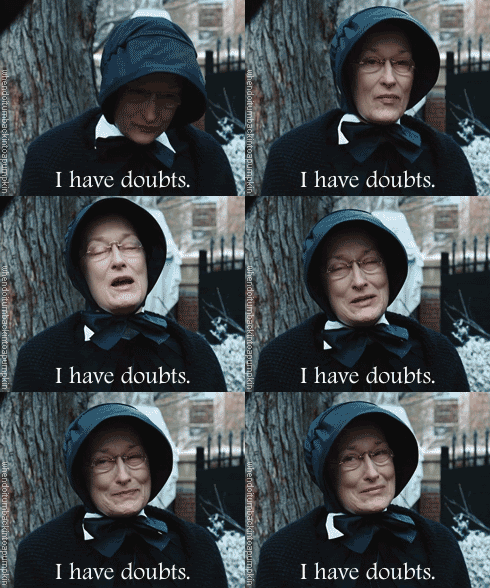
Homegoing deals with the slave trade that resulted in millions of men & women being uprooted from Africa and shipped to the United States of America to undergo abominable treatment in the hands of white men. I was nervous about this book at first because I know that the author is a 26 years old immigrant from Ghana not an old, wizened African American lady writing about a history she either knows firsthand or via tales handed down to her from generation to generation. As much as it makes me cringe to admit it, I wondered if this was Yaa Gyasi's "story to tell".  I was worried that this whole thing might come off as a ROOTS (the miniseries) wannabe. I was worried that Homegoing (305 pages) would reek of researched content that would render it lifeless, a big bulky mess in the end. The most appropriate GIF that immediately came to mind to mirror my thoughts before and during the first few pages of Homegoing is this scene with Meryl Streep (one of my favorite actresses in the world) from the movie Doubt. 


Homegoing at HARVARD
I had so many doubts but I was rooting for Gyasi to triumph. And she did. She freaking did. Gyasi's writing is confident, commanding, and effortless like this isn't her first rodeo. Homegoing weaves stories across generations, across cultures, and across continents, a terrifyingly ambitious undertaking. It's the first novel I've read that tells the slave trade story from the African perspective. Gyasi takes us to these characters in whatever corner they may be, either living with family or weathering loneliness, some knowledgeable about their ancestral roots and others not so aware. They are split up just like slavery split up millions of families and you yearn for them to reunite but you know for this plotline to pay true homage to our ancestors they shouldn't reunite because in real life lots of black families did not reunite. By the end of Ness's story on page 87 I was certain our ancestors gave Yaa Gyasi the talent, wisdom and fortitude required to tell this story and that they would be so proud if they could read this. As I neared the end of Homegoing and in the ensuing silence after I finished it (including the Acknowledgments), I was more aware of the magnitude of this project, of this literary achievement, this gift that was crafted by the amazing Yaa Gyasi.

Homegoing is one of the most inspiring books I've ever read. I'm so proud. I'm so moved. I'm ready to stand on the street corner selling copies of this book. I saw it displayed in the window of the HARVARD Bookstore late September when I visited and I was like "yessssss...". You need to read this book. BUY it. BORROW it. Just find some way to READ IT.

[Book Cover Image via Amazon, GIF via ReactionGifs

September 14, 2016

Like a Mule Bringing Ice Cream to the Sun by Sarah Ladipo Manyika | Book Review

Morayo is an elderly woman living in San Francisco, California. She lives alone with her multitude of books in a prized apartment with a choice view of the city. She has never had children and she has no family member geographically close enough to be there for her when she needs it. She used to be a Professor of English and she also used to be married to an ambassador. Using flashbacks and the narration of other characters in Morayo's life, Manyika gives us a great perspective of the life Morayo now lives. Like a Mule Bringing Ice Cream to the Sun is a portrait of a woman who's living out the last years of her life the best way she can.

I honestly couldn't wait to be done with this novel. Honestly. The knowledge that it had just 118 pages kept me going because I knew I could do it if I just kept at it. I like Sarah Ladipo Manyika. I enjoyed and reviewed her first novel In Dependence and I even interviewed her for this blog in the post 12 Questions for Sarah Ladipo Manyika back in 2009. Morayo's story is boring. It has no spark. I understand that it's a story about an elderly woman but I wanted it to be much more than this. It's all good though. I'll still be in line for Manyika's next novel.

[Image via Amazon]

September 10, 2016

Book Release!!! | "The Path Which Shapes Us" by Lazola Pambo

The Path Which Shapes Us is a young adult fiction novel written by South African poet, novelist and essayist, Lazola Pambo. Its protagonist Clifford Malothi is caught up in his Uncle's past criminal life and lives in fear of being kidnapped along with his girlfriend. His Uncle's nemesis, Nasty Mike, is a threat to his Uncle and all the people of Evansdale, Clifford's hometown. The only one who can save them is Clifford and he has the perfect plan to overcome Nasty Mike.

Lazola Pambo has had his works published in New Coin, LitNet, The Kalahari Review, Aerodome, Nomad's Choir, Black Magnolias Literary Journal, BlazeVOX, Indiana Voice Journal, and Aji Magazine. He will soon be published in The Sentinel Literary Quarterly. This is his first novel. You can follow him on Twitter: @LPambo

The Path Which Shapes Us will retail for the price of R159,99. It will be available in South African bookstores and online by the end of September 2016. Orders can be sent in advance of release date to the book publisher. Contact: Mr. Isaac Shabangu via email - isaac@linguafrancapublishers.co.za


September 07, 2016

July's People by Nadine Gordimer | Book Review

Bam and Maureen Smales are a caucasian couple with three kids living in apartheid South Africa. This story begins with them in a village hut being attended to by their black manservant, July. The sudden war in South Africa, a product of racial tensions, has forced everyone to flee the cities and the Smales family is in especial danger because of their race. July's extended family aren't welcoming but they take the Smales in. July's mom even vacates her personal hut at his request so the Smales can stay in it. The plan seems to be to hide out in July's village until it's safe but tensions are rising within the camp. For 15 years July has been the paid manservant who does their bidding but now the Smales are helpless and dependent on July for a lot of things, including their safety. Will they continue to stay with July's People or will they head out on their own?

July's People is about the racism in South Africa at a certain point in time. The story doesn't start out in an exciting way and for a while the only reason I'm clinging on is because it's written by Nadine Gordimer. She's a revered South African author. She won the Booker Prize in 1974 and the Nobel Prize for Literature in 1991. I've wanted to read her books for some time now and I initially planned to start with The Conservationist but I changed my mind. Anyway, July's People doesn't build up to some great tragedy or jaw dropping event. It just keeps trudging along for 160 pages. Do I like July's People? Yeah, it was okay... Would I recommend it to anyone? No.

[Image via Amazon]

August 07, 2016

A Dry White Season by Andre Brink | Book Review

We're told right from the beginning about the troubling deaths of two black South Africans: Gordon Ngubene and his son Jordan. Gordon used to be a janitor at the school where Ben Du Toit, the protagonist, teaches history and geography. Gordon and Ben got to know each other better after Ben helped Gordon out of a tight spot. Ben also took on the responsibility of paying for Jordan's tuition because Jordan seemed like such a promising young kid. All that young promise vaporized when Jordan reached his mid-teens and morphed into a restless fool, boiling with teen angst and unwilling to continue schooling. It's not long before he disappears unexpectedly. There's something really shady about his disappearance and the subsequent police "investigation" that bothers Gordon. Gordon quits his job at the school and goes underground to investigate the circumstances surrounding his son's death but he also disappears and returns as a dead body. Ben Du Toit takes it upon himself to investigate the deaths of these two black men in apartheid South Africa. His hunt for truth and justice come at great personal cost and threatens everything he has - his family, his job, his privacy, his personal safety, and his mental health - but he ploughs on, impervious to the pleas of family and friends. Can Ben Du Toit expose South Africa's police and the country's corrupt legal system?

I dislike forewords, prologues, and introductions in novels. The more pages a writer devotes to his or her prologue, the less chance I'll read the entire thing. I always just want to begin at chapter one. Thankfully, I didn't read this particular foreword until I was done with the novel and its epilogue (I don't mind epilogues) because it would have ruined the entire novel for me. If you do decide to read the thirty-five pages of this novel's foreword there will be little surprise ahead for you and you're going to want to find a reason to keep flipping pages because A Dry White Season isn't that engrossing.

Ben Du Toit is a white man in a racially segregated South Africa who's deeply disturbed by the unjust treatment of blacks and the disgusting cover-ups of their murders by the government. With all of the issues at stake in this novel I expected to be on Ben's side but I'm not moved by him. His naivety is astounding, unnerving and irritating at times. The mere fact that a middle-aged man in that environment still had complete trust in the justice system caused me to lose faith in him and his ability to bring the killers to justice. Is Andre Brink using Ben Du Toit to depict the naivety that results from being in a privileged racial class or is Ben Du Toit just ignorant? Even his confrontation of authority was childish and reckless which is serious because of the potential consequences that could result from being so "fearless". Ben Du Toit is not a martyr for South African blacks but I applaud his earnest efforts and his pushing forth despite all odds. A Dry White Season feels like it's supposed to be a highly compelling portrait of the injustices in apartheid South Africa or something of that sort. I had some difficulty getting through it but in retrospect the novel seems more engaging than it really was. I wish it had been a much better read.

Image via [Goodreads]

July 07, 2016

Disgrace by J.M. Coetzee | Book Review

David Lurie is a fifty-two year old college professor in South Africa. He's a two-time divorcee and father to one child, his daughter Lucy. David lives alone and he has sorted his life into a routine that seems to be working well for him. He teaches a college class, grades papers, makes weekly trips to a brothel, and also engages in casual sexual encounters every now and then. He's quite content with the loneliness that comes with this freedom to do as he pleases. One day he runs into a girl who's a student in his college class. He invites her home and sometime later they begin having sexual relations until it all goes wrong. Horribly wrong. In the wake of the ensuing scandal his entire academic career and everything he has worked hard for are on the line. In the chaos you'd be forgiven to anticipate that the plot of Disgrace would head down a certain path but it doesn't. The path it takes instead is shocking and disturbing.

Disgrace is a great novel. I say that reluctantly not because I doubt its greatness but because of the story itself. I'm just a little reluctant to tie the word "great" to what goes on in this book. I put it down a lot so I could pause to sort out and cool the rising disquiet and the occasional horror. Thoughts like "What???", "What's going on???" "What are you saying???", and "Oh my God..." kept surfacing during my reading. Disgrace is not a convoluted tale that seeks to impress. It stays with you because it's so real. You know this is how life works in some parts of the world and it's frightening. It's messed up. It's so messed up. Our world is messed up. The point where Coetzee leaves us doesn't soothe the readers anxiety. I just sat there after I was done, trying to put it all together and also using my imagination to project what happens afterwards. Disgrace won the Man Booker Prize in 1999 making J.M. Coetzee a two time winner of the prestigious prize at the age of fifty-nine. You should read it.

[Image via Middlemiss