October 14, 2016

Born on a Tuesday by Elnathan John | Book Review

Dantala's a Muslim boy living in northern Nigeria. His dad is dead, his mother is a shell of her former self due to a family tragedy, and his siblings are scattered. At the beginning of the story he lives with a band of stray, unruly boys who survive the streets by letting themselves be used by political parties to carry out election mischief. He gets redeemed by a Sheikh and is able to live a different sort of life. It's a new chapter in his life and an important part of his growth into a man. A chance happening leads to a sexual awakening but not the kind of awakening a devout Muslim can afford to entertain. These feelings arouse, sober and repulse him. Will he suppress his feelings or seek outlets for exploration? While he deals with that deals with his inner turmoil there are important, life-threatening issues needing attention. His father figure, the Sheikh, and Mallam Abdul-Nur are the heads of two factions who are continuously in discord about what Islam should mean, especially in the wake of international terrorist attacks, and what is the best path going forward both for their community and Islam in general. Tensions rise, things escalate, and people fall left and right.

I haven't read a lot of novels set in northern Nigeria and featuring Muslim protagonists. It makes this book especially more important in the overall quest for more diverse voices from Nigeria and the African continent. While reading Born on a Tuesday and after I was done with it I kept thinking that the novel would mean a little more and I would feel a little more if I could really understand the context of the life portrayed and the gravity of its weighty issues. I'm not saying only northerners or those with a Muslim background would understand Born on a Tuesday. I'm saying I'd probably be a little more heartbroken at the end if I had been able to connect to all of this a little more. I first read Elnathan John in the The Caine Prize for African Writing 2015 Anthology titled Lusaka Punk and Other Stories. I liked his short story Flying. Born on a Tuesday is a good read.

READ:
The Caine Prize for African Writing 2015 Anthology | Book Review

[Image via Amazon]

October 07, 2016

Homegoing by Yaa Gyasi | Book Review

Homegoing begins with the nighttime birth of Effia Otcher, one of the two great ancestresses whose lineages we will follow to the end. We see Effia grow, get married off to a white colonialist named James Collins, and birth a boy named Quey. The three of them live in a castle that holds captives in its murky dungeons. Esi is the other great ancestress. We catch her just as she turns fifteen while in the dungeon of Cape Coast Castle, a holding place for kidnapped persons just before they are shipped off to the United States of America to serve as slaves. Each chapter in  Homegoing is about a character; each character is a descendant of one of these two ancestresses. We follow these descendants from chapter to chapter, life story to life story, in sickness and in health, till death (sometimes), and then we part. They head off to the afterlife and we, witnesses to their immense pain and suffering, head back to our daily lives incredibly moved and much more aware of the horrors of our history.

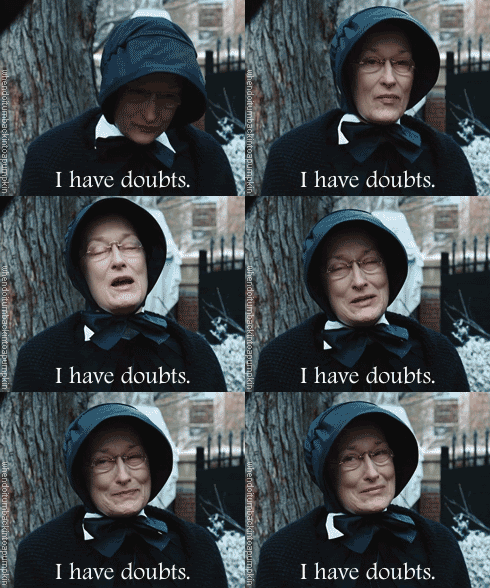
Homegoing deals with the slave trade that resulted in millions of men & women being uprooted from Africa and shipped to the United States of America to undergo abominable treatment in the hands of white men. I was nervous about this book at first because I know that the author is a 26 years old immigrant from Ghana not an old, wizened African American lady writing about a history she either knows firsthand or via tales handed down to her from generation to generation. As much as it makes me cringe to admit it, I wondered if this was Yaa Gyasi's "story to tell".  I was worried that this whole thing might come off as a ROOTS (the miniseries) wannabe. I was worried that Homegoing (305 pages) would reek of researched content that would render it lifeless, a big bulky mess in the end. The most appropriate GIF that immediately came to mind to mirror my thoughts before and during the first few pages of Homegoing is this scene with Meryl Streep (one of my favorite actresses in the world) from the movie Doubt. 


Homegoing at HARVARD
I had so many doubts but I was rooting for Gyasi to triumph. And she did. She freaking did. Gyasi's writing is confident, commanding, and effortless like this isn't her first rodeo. Homegoing weaves stories across generations, across cultures, and across continents, a terrifyingly ambitious undertaking. It's the first novel I've read that tells the slave trade story from the African perspective. Gyasi takes us to these characters in whatever corner they may be, either living with family or weathering loneliness, some knowledgeable about their ancestral roots and others not so aware. They are split up just like slavery split up millions of families and you yearn for them to reunite but you know for this plotline to pay true homage to our ancestors they shouldn't reunite because in real life lots of black families did not reunite. By the end of Ness's story on page 87 I was certain our ancestors gave Yaa Gyasi the talent, wisdom and fortitude required to tell this story and that they would be so proud if they could read this. As I neared the end of Homegoing and in the ensuing silence after I finished it (including the Acknowledgments), I was more aware of the magnitude of this project, of this literary achievement, this gift that was crafted by the amazing Yaa Gyasi.

Homegoing is one of the most inspiring books I've ever read. I'm so proud. I'm so moved. I'm ready to stand on the street corner selling copies of this book. I saw it displayed in the window of the HARVARD Bookstore late September when I visited and I was like "yessssss...". You need to read this book. BUY it. BORROW it. Just find some way to READ IT.

[Book Cover Image via Amazon, GIF via ReactionGifs

September 14, 2016

Like a Mule Bringing Ice Cream to the Sun by Sarah Ladipo Manyika | Book Review

Morayo is an elderly woman living in San Francisco, California. She lives alone with her multitude of books in a prized apartment with a choice view of the city. She has never had children and she has no family member geographically close enough to be there for her when she needs it. She used to be a Professor of English and she also used to be married to an ambassador. Using flashbacks and the narration of other characters in Morayo's life, Manyika gives us a great perspective of the life Morayo now lives. Like a Mule Bringing Ice Cream to the Sun is a portrait of a woman who's living out the last years of her life the best way she can.

I honestly couldn't wait to be done with this novel. Honestly. The knowledge that it had just 118 pages kept me going because I knew I could do it if I just kept at it. I like Sarah Ladipo Manyika. I enjoyed and reviewed her first novel In Dependence and I even interviewed her for this blog in the post 12 Questions for Sarah Ladipo Manyika back in 2009. Morayo's story is boring. It has no spark. I understand that it's a story about an elderly woman but I wanted it to be much more than this. It's all good though. I'll still be in line for Manyika's next novel.

[Image via Amazon]

September 10, 2016

Book Release!!! | "The Path Which Shapes Us" by Lazola Pambo

The Path Which Shapes Us is a young adult fiction novel written by South African poet, novelist and essayist, Lazola Pambo. Its protagonist Clifford Malothi is caught up in his Uncle's past criminal life and lives in fear of being kidnapped along with his girlfriend. His Uncle's nemesis, Nasty Mike, is a threat to his Uncle and all the people of Evansdale, Clifford's hometown. The only one who can save them is Clifford and he has the perfect plan to overcome Nasty Mike.

Lazola Pambo has had his works published in New Coin, LitNet, The Kalahari Review, Aerodome, Nomad's Choir, Black Magnolias Literary Journal, BlazeVOX, Indiana Voice Journal, and Aji Magazine. He will soon be published in The Sentinel Literary Quarterly. This is his first novel. You can follow him on Twitter: @LPambo

The Path Which Shapes Us will retail for the price of R159,99. It will be available in South African bookstores and online by the end of September 2016. Orders can be sent in advance of release date to the book publisher. Contact: Mr. Isaac Shabangu via email - isaac@linguafrancapublishers.co.za


September 07, 2016

July's People by Nadine Gordimer | Book Review

Bam and Maureen Smales are a caucasian couple with three kids living in apartheid South Africa. This story begins with them in a village hut being attended to by their black manservant, July. The sudden war in South Africa, a product of racial tensions, has forced everyone to flee the cities and the Smales family is in especial danger because of their race. July's extended family aren't welcoming but they take the Smales in. July's mom even vacates her personal hut at his request so the Smales can stay in it. The plan seems to be to hide out in July's village until it's safe but tensions are rising within the camp. For 15 years July has been the paid manservant who does their bidding but now the Smales are helpless and dependent on July for a lot of things, including their safety. Will they continue to stay with July's People or will they head out on their own?

July's People is about the racism in South Africa at a certain point in time. The story doesn't start out in an exciting way and for a while the only reason I'm clinging on is because it's written by Nadine Gordimer. She's a revered South African author. She won the Booker Prize in 1974 and the Nobel Prize for Literature in 1991. I've wanted to read her books for some time now and I initially planned to start with The Conservationist but I changed my mind. Anyway, July's People doesn't build up to some great tragedy or jaw dropping event. It just keeps trudging along for 160 pages. Do I like July's People? Yeah, it was okay... Would I recommend it to anyone? No.

[Image via Amazon]

August 07, 2016

A Dry White Season by Andre Brink | Book Review

We're told right from the beginning about the troubling deaths of two black South Africans: Gordon Ngubene and his son Jordan. Gordon used to be a janitor at the school where Ben Du Toit, the protagonist, teaches history and geography. Gordon and Ben got to know each other better after Ben helped Gordon out of a tight spot. Ben also took on the responsibility of paying for Jordan's tuition because Jordan seemed like such a promising young kid. All that young promise vaporized when Jordan reached his mid-teens and morphed into a restless fool, boiling with teen angst and unwilling to continue schooling. It's not long before he disappears unexpectedly. There's something really shady about his disappearance and the subsequent police "investigation" that bothers Gordon. Gordon quits his job at the school and goes underground to investigate the circumstances surrounding his son's death but he also disappears and returns as a dead body. Ben Du Toit takes it upon himself to investigate the deaths of these two black men in apartheid South Africa. His hunt for truth and justice come at great personal cost and threatens everything he has - his family, his job, his privacy, his personal safety, and his mental health - but he ploughs on, impervious to the pleas of family and friends. Can Ben Du Toit expose South Africa's police and the country's corrupt legal system?

I dislike forewords, prologues, and introductions in novels. The more pages a writer devotes to his or her prologue, the less chance I'll read the entire thing. I always just want to begin at chapter one. Thankfully, I didn't read this particular foreword until I was done with the novel and its epilogue (I don't mind epilogues) because it would have ruined the entire novel for me. If you do decide to read the thirty-five pages of this novel's foreword there will be little surprise ahead for you and you're going to want to find a reason to keep flipping pages because A Dry White Season isn't that engrossing.

Ben Du Toit is a white man in a racially segregated South Africa who's deeply disturbed by the unjust treatment of blacks and the disgusting cover-ups of their murders by the government. With all of the issues at stake in this novel I expected to be on Ben's side but I'm not moved by him. His naivety is astounding, unnerving and irritating at times. The mere fact that a middle-aged man in that environment still had complete trust in the justice system caused me to lose faith in him and his ability to bring the killers to justice. Is Andre Brink using Ben Du Toit to depict the naivety that results from being in a privileged racial class or is Ben Du Toit just ignorant? Even his confrontation of authority was childish and reckless which is serious because of the potential consequences that could result from being so "fearless". Ben Du Toit is not a martyr for South African blacks but I applaud his earnest efforts and his pushing forth despite all odds. A Dry White Season feels like it's supposed to be a highly compelling portrait of the injustices in apartheid South Africa or something of that sort. I had some difficulty getting through it but in retrospect the novel seems more engaging than it really was. I wish it had been a much better read.

Image via [Goodreads]

July 07, 2016

Disgrace by J.M. Coetzee | Book Review

David Lurie is a fifty-two year old college professor in South Africa. He's a two-time divorcee and father to one child, his daughter Lucy. David lives alone and he has sorted his life into a routine that seems to be working well for him. He teaches a college class, grades papers, makes weekly trips to a brothel, and also engages in casual sexual encounters every now and then. He's quite content with the loneliness that comes with this freedom to do as he pleases. One day he runs into a girl who's a student in his college class. He invites her home and sometime later they begin having sexual relations until it all goes wrong. Horribly wrong. In the wake of the ensuing scandal his entire academic career and everything he has worked hard for are on the line. In the chaos you'd be forgiven to anticipate that the plot of Disgrace would head down a certain path but it doesn't. The path it takes instead is shocking and disturbing.

Disgrace is a great novel. I say that reluctantly not because I doubt its greatness but because of the story itself. I'm just a little reluctant to tie the word "great" to what goes on in this book. I put it down a lot so I could pause to sort out and cool the rising disquiet and the occasional horror. Thoughts like "What???", "What's going on???" "What are you saying???", and "Oh my God..." kept surfacing during my reading. Disgrace is not a convoluted tale that seeks to impress. It stays with you because it's so real. You know this is how life works in some parts of the world and it's frightening. It's messed up. It's so messed up. Our world is messed up. The point where Coetzee leaves us doesn't soothe the readers anxiety. I just sat there after I was done, trying to put it all together and also using my imagination to project what happens afterwards. Disgrace won the Man Booker Prize in 1999 making J.M. Coetzee a two time winner of the prestigious prize at the age of fifty-nine. You should read it.

[Image via Middlemiss

June 07, 2016

Nervous Conditions by Tsitsi Dangaremgba | Book Review

In Nervous Conditions, Tambudzai is an ambitious young girl living in a small village in Zimbabwe who has a lot of obstacles blocking her path to getting an education. Her father is poor, lazy and obnoxious. He's irritated by Tambudzai's efforts to get an education. "Can you cook books and feed them to your husband? Stay at home with your mother. Learn to cook and clean. Grow vegetables." Tambudzai's mother is less unpleasant when she voices her willingness to farm on a piece of land to raise money for her school fees but she's not rooting for Tambudzai either. Her older brother Nhamo gets his education paid for by their benevolent uncle, Babamukuru, because Nhamo's smart and also because their patriarchal society places more value on male children. Nhamo is vicious and cruel in his treatment of Tambudzai and in his continously taunting dismissal of her ambitions and dreams. When Tambudzai finally gets the green light from her parents to grow maize so she can sell and pay her own tuition, Nhamo sabotages her efforts by stealing her crops and handing them out for free to the girls at Tambudzai's school. The very minute Tambudzai discovers his treachery she attacks him on the football field, knocking him down and dealing him all the blows she can muster before he finally pins her to the ground and taunts her in front of everyone. For Tambudzai, life's a constant battle but she's a fighter. That and a little help from Providence give her the little push she needs as she pursues her heart's desires.

This is a good story about a young girl's ambition and fight to get what she wants in life. Tambudzai isn't surrounded by educated women but she has great examples of women in her life. She has living examples of both the kind of woman she wants to be and the kind of woman she doesn't want to be. She knows women who put their foot down when it's necessary. She knows women who are not afraid to confront the scummy men in their lives. She knows women who fall and get up. She knows women who fight battles every single day. Nervous Conditions was published in 1988, the year I was born. It's almost thirty years old. Readers now will likely label this a feminist text and while it is I would like to point out that these are women all of us knew while growing up. We've known them all our lives. They are normal women. Everyday women. They are our grandmothers, mothers, aunties, sisters and friends. I like this novel. You should read it.

[Image via Amazon]

May 14, 2016

What Is Not Yours Is Not Yours by Helen Oyeyemi | Book Review

What Is Not Yours Is Not Yours is a collection of nine short stories, four of which have been published previously in various journals. It begins with Books and Roses then continues with Sorry Doesn't Sweeten her Tea, Is Your Blood as Red as This?, Drownings, Presence, A Brief History of the Homely Wench Society, Darnicka and the St. Martin's Day Goose, Freddy Barrandov Checks...in?, and ends with If a Book is Locked There's Probably a Good Reason for That Don't You Think? Of the lot I liked the second, seventh, and ninth stories with the ninth one being my favorite.

What Is Not Yours Is Not Yours is the fourth Oyeyemi title I've read out of the six she has published so far (I'm not counting the book of plays) and I still have the same problems that I always have when I read an Oyeyemi novel. I have a problem connecting with her stories... It's not because her main characters are sometimes caucasian as opposed to being Nigerian or having an African ancestry. I grew up devouring stories about caucasian characters in novels written by caucasian authors just like every other Nigerian in my generation so I can connect to anyone regardless of race, that's not a problem. Oyeyemi has a penchant for penning mystical stories or stories with fairytale-y roots and while that's not my thing in this phase of my life, I still expect to enjoy these stories or at least appreciate them but most of the time I do not. What Is Not Yours Is Not Yours was a struggle to read and I was glad when I was away from the book even though I was on a tight reading schedule in the first quarter of 2016. When I finally finished it, I still got the "I finished this story but I don't know exactly what I read" feeling that comes often when I read an Oyeyemi title.

January 30th, 2004 edition of The Guardian
I purchased White Is for Witching via Amazon in April 2013 and I still can't get past the first few pages. I've thumbed through White Is for Witching many times over the past three years just to see if it gets better somewhere (usually that encourages me to give the book another shot) but that hasn't worked. Every now and then I search for Mr. Fox on Amazon and preview it using Amazon's "Look Inside" feature but I can tell it's not good for me so I never buy it. I don't know... Maybe Oyeyemi's books are not for me. I don't want to keep battling through her novels only to arrive at the other end to write a review saying how much I don't like it. That's a waste of my time and yours. Especially here in America where there are millions of novels, sitting in gorgeous, air-conditioned buildings that are too nice to house only books, begging to be read. I have decided that I'm going step back for a while and when I'm ready I'll be much more thorough before I select and purchase another another Oyeyemi book. Someone somewhere is going to call me a hater but I'm not a hater. I really want to connect to Oyeyemi's stories. There are only three Nigerian authors whose interviews/features I have cut out of newspapers and Oyeyemi is one of them. I even brought the 2004 newspaper clipping with me when I moved to America in 2009. Above is a photo of my newspaper clipping along with my copy of this novel. It's from the January 30th, 2004 edition of Nigeria's The Guardian. I clearly did a lot of highlighting lol. I have posted this photo to show I'm not some hater. This review is just me trying to be honest about an author I care about and someone whose career I have followed for quite some time.

Helen Oyeyemi is amazing. It's something I've always admitted. It's something that's unquestionable. Half the time when I read her books I'm wondering how she makes all of this stuff up. She's impressive. I'll wait. I'll try to not just buy another novel because it's an Oyeyemi book. The future will bring me an Oyeyemi offering that will excite me just as much or even more than The Icarus Girl did in 2008. I know it will.
---
READ: 
The Icarus Girl by Helen Oyeyemi - My Thoughts 
The Opposite House by Helen Oyeyemi - My Thoughts
Boy, Snow, Bird by Helen Oyeyemi - My Thoughts

[Image via Amazon]

May 07, 2016

The Beautiful Things That Heaven Bears by Dinaw Mengestu | Book Review

Stephanos is a lonely shopkeeper living in Washington D.C. He fled the turmoil in Ethiopia almost two decades ago. He has no drive or ambition and is simply content to drift along from day to day. He's not going anywhere with his life and he's not doing anything to change that. After almost two decades in America, the only people he can call on are his Uncle and two friends - Kenneth and Joe. Kenneth and Joe are also immigrants and as a trio their companionship is heartwarming. Their American story began with dreams of grandeur and hopes of a brighter future but life has settled into a routine over the years. They have achieved some of their goals (mostly Kenneth and Joe) but no one has achieved the level of success they imagined. They still have those dreams but their optimism has waned. The loneliness in their lives can be felt and I found it captivating. Along comes Judith and Naomi to Stephanos neighborhood. Judith is a single caucasian mom and Naomi is her eleven years old African American daughter. They soon become a light in Stephanos' otherwise miserable daily existence and he slowly grows to depend their presence to brighten up his day. On the outside Stephanos is a skinny, lonely man who doesn't have his life on track but it's because he's broken on the inside and it's taking everything he can muster to keep it together and get from day to day.

The Beautiful Things That Heaven Bears is Dinaw Mengestu's debut novel and it's fantastic. In 2014 I read his third novel All Our Names and I was not impressed but there was something about him that caught my attention. In that book review I wrote:

"I'll buy and review Dinaw's first and second novels [...] One or both of them had to have been mightily impressive enough to get him noticed and I really want to see him at his best. All Our Names is not Dinaw Mengestu at his best. It can't be." 

So I ordered his first two novels and I started by reading this one. I was riveted with this story from the very beginning. I took it in slowly, marking sentences with my colored pens and leaving page marker post-its on almost every page. The Beautiful Things That Heaven Bears is life on two hundred and twenty eight pages. The plot, the narration, everything, seemed so effortless and it was all sooo good. I was hooked. I did not want to put it down. I read it from 7pm on Monday till 5am on Tuesday and I would have finished it if I had been able to fight off sleep. This is that debut novel that pulls its author to the front of the literary pack. I love this novel sooo much but I hated the way it ended. I had been rooting for Stephanos all through the novel in-spite of his flaws and I kept hoping he would shake off his lethargy somehow and grab life by the horns. All of that goodwill went down the drain when I read page 227, the page before the last page of the novel. I hated the choice he made on that page especially because it was one more addition onto the pile of choices he had made that I did not approve of. It was maddening. If someone reaches out to you on this lonely planet, especially someone who genuinely likes you and you like that person back, you ought to reach right back. For a man his age, I hated his hesitancy and his lack of confidence even though I understood it. So I finished the last page of The Beautiful Things That Heaven Bears with a sudden pulsating headache because I was so mad at Stephanos. What is wrong with you???? In the great words of Tyra Banks:
And then I picked up another novel hoping to get this one off my mind.

I love it, I love it, I love it, I love it. Fantastic job Dinaw! Great job! I'm glad I followed through on my hunch that his third novel wasn't his best. I've got one more novel of his to read, his second book How to Read Air. I'm on a journey to discover Mengestu and I'm really hoping that All Our Names is his worst novel thus far.
---
READ:
All Our Names by Dinaw Mengestu - My Thoughts

[Book cover image via Amazon; Tyra Banks gif via NewNowNext]